Hanshin Neji Blog: How Much Thread Engagement Length Do You Really Need?
76 Views |

Hello everyone! This is Yamazato from Hanshin Neji. Today, I’d like to write about a question I actually received during one of our screw and fastener seminars at a customer's site: "What is the appropriate thread engagement length?"
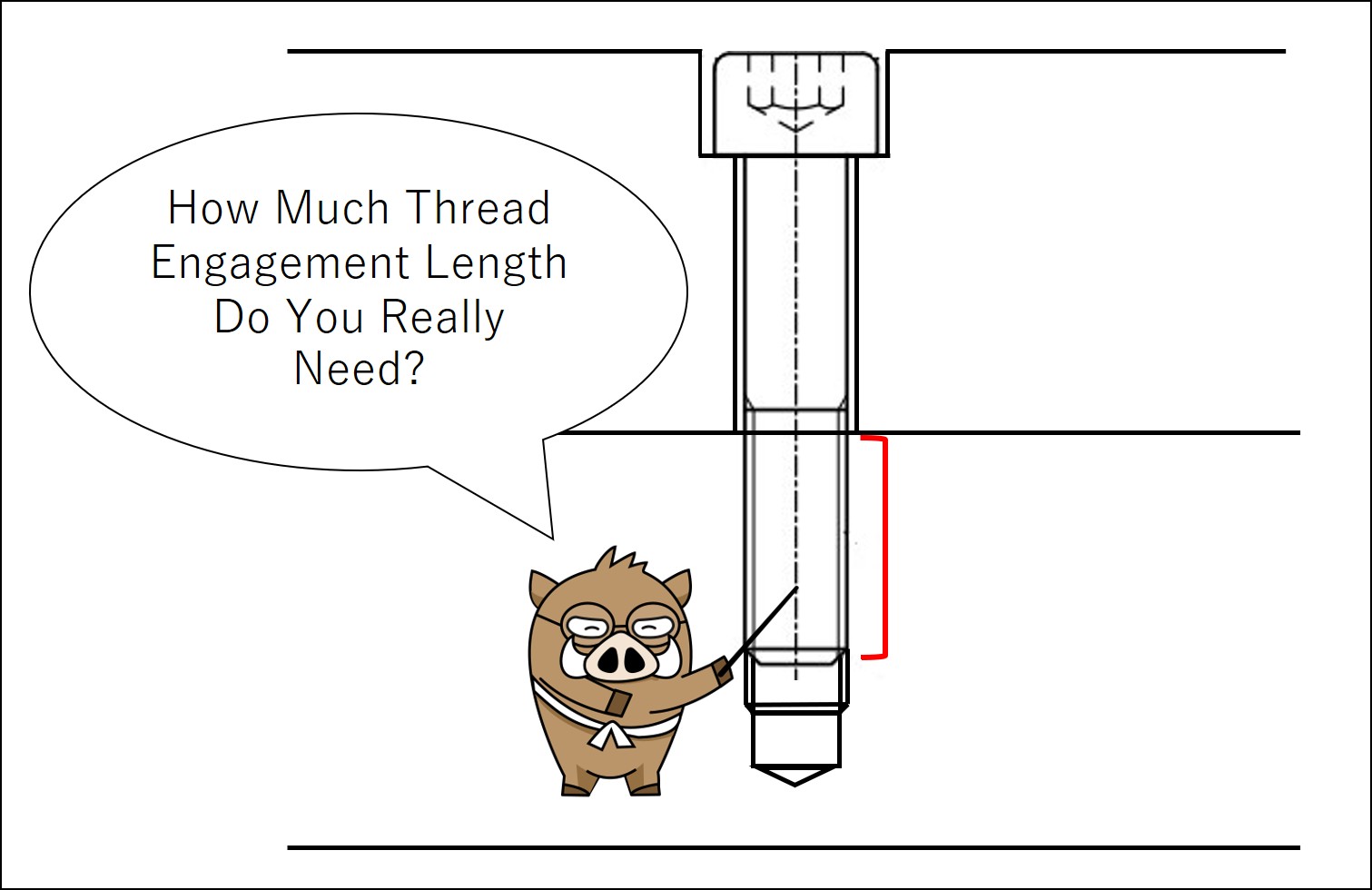
For example, when doing maintenance on molds and dies, how deep should you tap a new or repaired internal thread? A common story I hear in Mexico is that people think "the longer, the better," so they drill incredibly deep holes and thread them all the way down. While it might seem like this ensures a tighter, more secure fasten, it feels like a waste of time and effort when you consider work efficiency. So, what is the ideal thread engagement length?
I hope this information helps you with your manufacturing process. Thank you for reading!
1. General Rule of Thumb
The ideal thread engagement length depends on the materials (strength) of the bolt and the internal thread, as well as their combination. For instance, if the internal thread material is soft (like aluminum), you need longer engagement. If it is hard steel, it doesn’t need to be as long.
Here is a simple guidelines:
| Bolt Material × Base Material (Internal Thread) | Required Engagement Length |
| Steel (Bolt) × Steel (Base Material) | 0.8 to 1.0 times the screw diameter |
| Steel (Bolt) × Cast Iron / Brass | 1.5 times the screw diameter |
| Steel (Bolt) × Soft Materials (Aluminum, etc.) | 2.0 times the screw diameter |
Examples:
Steel Bolt + Steel Internal Thread (using anM10 bolt): 10 mm × 1.0 = 10 mm
Steel Bolt + Cast Iron Internal Thread (using an M16 bolt): 16 mm × 1.5 = 24 mm
2. What Is the Science Behind This Rule?
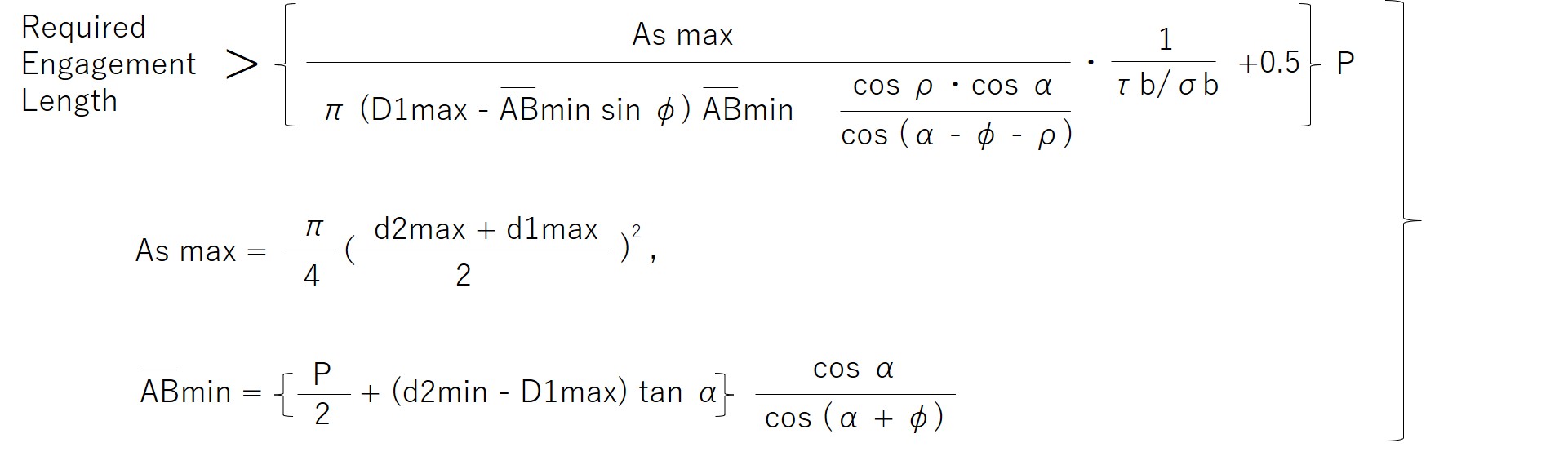
The underlying calculation formulas come from a chapter titled "Static Strength and Critical Engagement Length of Threads" in the book Principles and Design of Screw Fastening by Akira Yamamoto.
Don't worry, I won't make you stare at complex mathematical formulas today! In reality, calculating the exact engagement length requires numerous formulas before and after the main equation. Since explaining the pure mathematics is impossible for me (haha), let me explain the core concept of what these formulas are doing.
3. The Goal: Prevent Thread Stripping Under Tension!
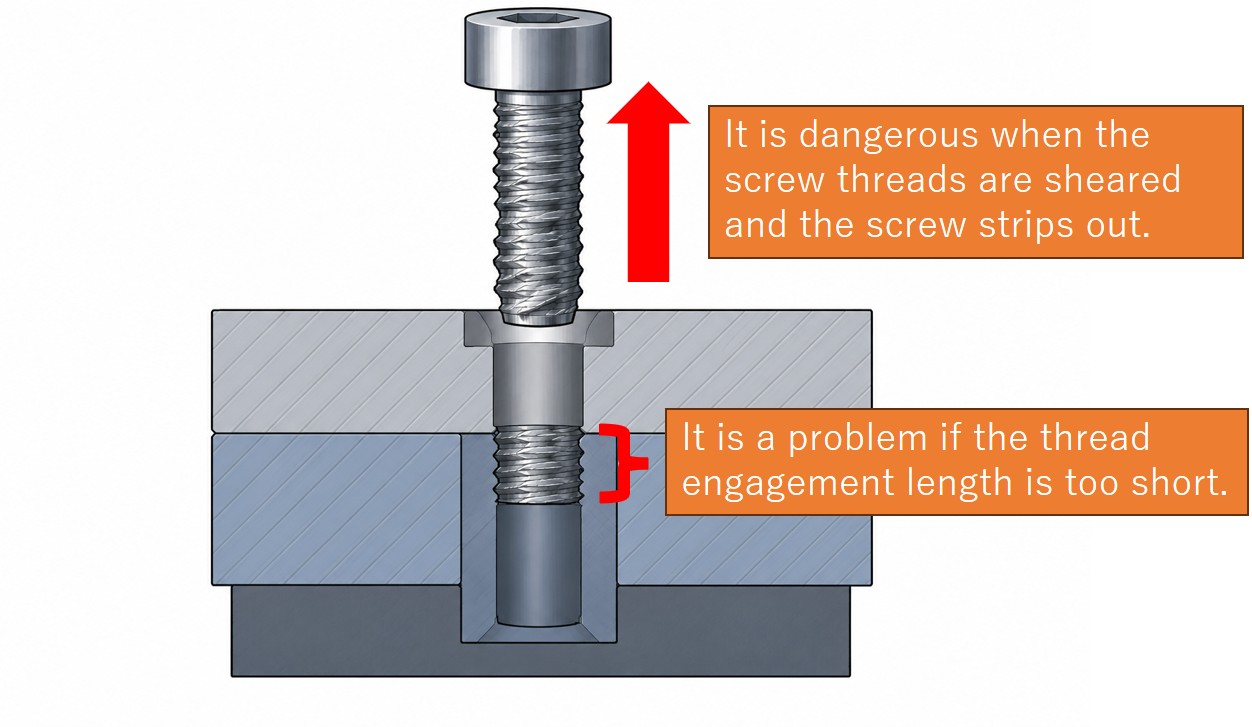
The most important point in fastener design is ensuring that the male and female threads do not "strip" (shear) before the bolt body itself breaks. "Stripping" means that when tension is applied to the screw, the thread ridges suffer shear failure, causing the bolt to pull straight out. This is highly dangerous because it means the joint fails in an unpredictable, uncalculated manner.
From a safety and engineering standpoint, it is crucial that the engaged threads hold strong so that if a load exceeds the tensile strength, the bolt body snaps rather than the threads stripping.
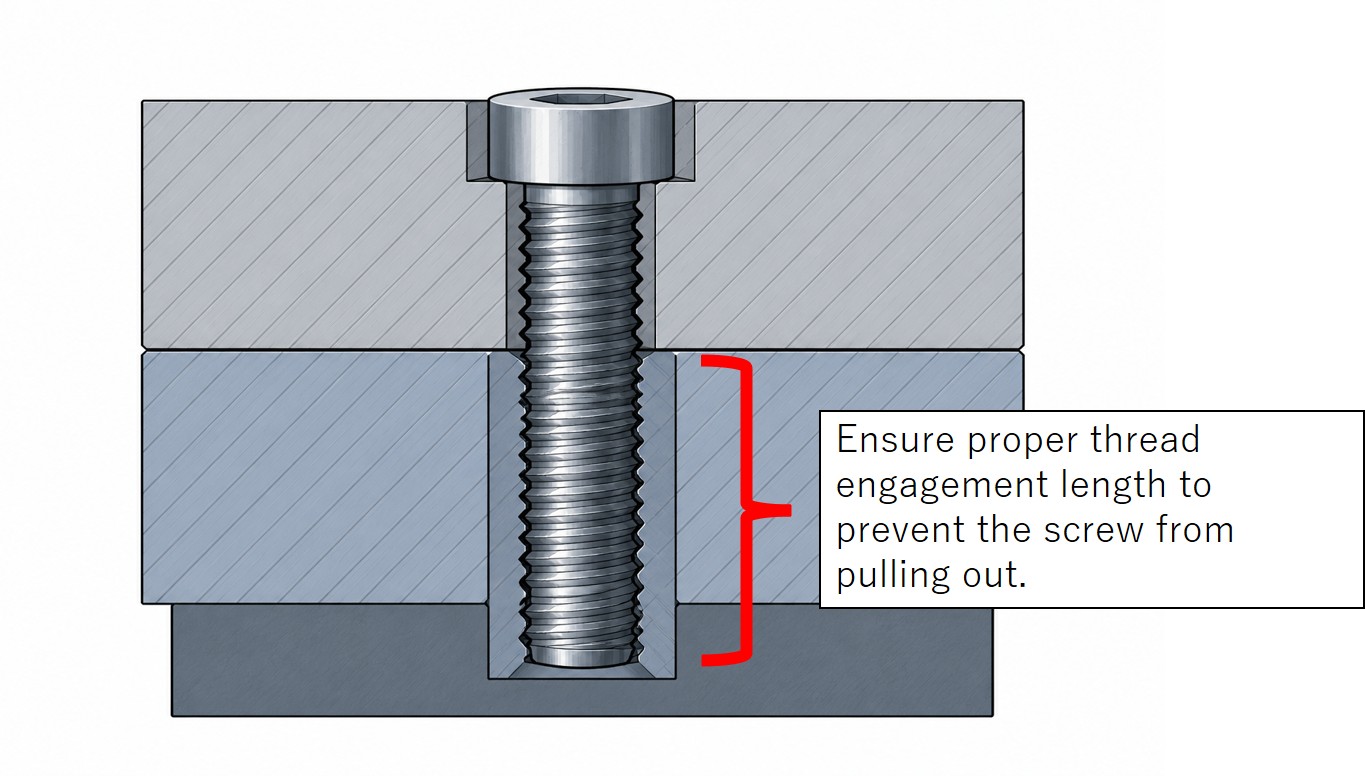
To determine this, the formulas calculate the following steps:
(Step1) The force required to snap the bolt body: Calculated by multiplying the bolt's tensile strength by its cross-sectional area. The thread engagement must be strong enough to withstand this force.
(Step2) The force that causes the threads to crush and strip: This is calculated for both the male (bolt) and female (internal) threads.
(Step3) The load capacity per 1 mm of thread engagement depth.
(Step4) The minimum required engagement length: Calculated by dividing the force needed to snap the bolt (Step 1) by the capacity per millimeter (Step 3).
The final safety margin:
(Step5) We add a little extra length just to be safe.
The formulas in the book account for microscopic variables like manufacturing tolerances, thread surface friction angles, and subtracting the unengaged chamfered areas. It is definitely not a random guess!
The book also includes quick-reference tables. For example, when pairing a high-strength 10.9 bolt (100 kg/mm²) with a cast iron base (20 kg/mm²), you divide 100 by 20 to get 5. Looking at the reference chart with this factor, you can quickly find that for an M10 bolt, the ideal engagement length is the nominal diameter multiplied by 1.1.
4. Summary
In everyday practice, using the general rules of thumb is perfectly fine. However, it’s good to know that the underlying reason is to calculate the exact contact area (engagement length) required so that the threads can hold strong until the point of total destruction.
Therefore, if the bolt is overwhelmingly stronger than the base material, you will naturally need a longer engagement length. Conversely, if their strengths are similar, a shorter length is sufficient. Fastener engineering is always so deep and fascinating!
If you have any questions about thread engagement lengths or any other fastener needs, please feel free to contact Hanshin Neji. We are always happy to help!
Editor's Note (Postscript)
On a personal note, I recently took a trip to Oaxaca, Mexico.
Google Maps Link
When I asked our Mexican employees and friends where the best place to travel in Mexico was, a huge majority answered "Oaxaca," so I had been wanting to go for a long time. At first, when I heard "Oaxaca," it sounded like the Japanese word ohaka (grave/cemetery), which sounded a bit unlucky! But since everyone highly recommended it, I went with my family.
The verdict? It was absolutely amazing. The food was delicious, and the city had a wonderful, relaxed atmosphere that felt very different from Querétaro, León, or Mexico City. There were art galleries everywhere with free admission, so even though I don't have an artistic eye, I thoroughly enjoyed exploring them. If you get the chance, I highly recommend visiting!

Atmosphere that truly makes you feel Mexico

Oaxaca is full of museums and galleries

The childhood home of Benito Juárez (the first indigenous president of Mexico)

Famous for Mole (a rich sauce made of ground chili peppers, spices, nuts, and fruits)

My first time watching Lucha Libre! The wrestlers were incredibly friendly and took photos with us

The food was fantastic too! (Though I barely took any photos of it, haha)


